Scrum That Actually Works (and the Failure Modes That Turn It Into Theater)

Scrum doesn't fail because engineers can't estimate.
It fails because organizations can't protect focus and respect decision rights.
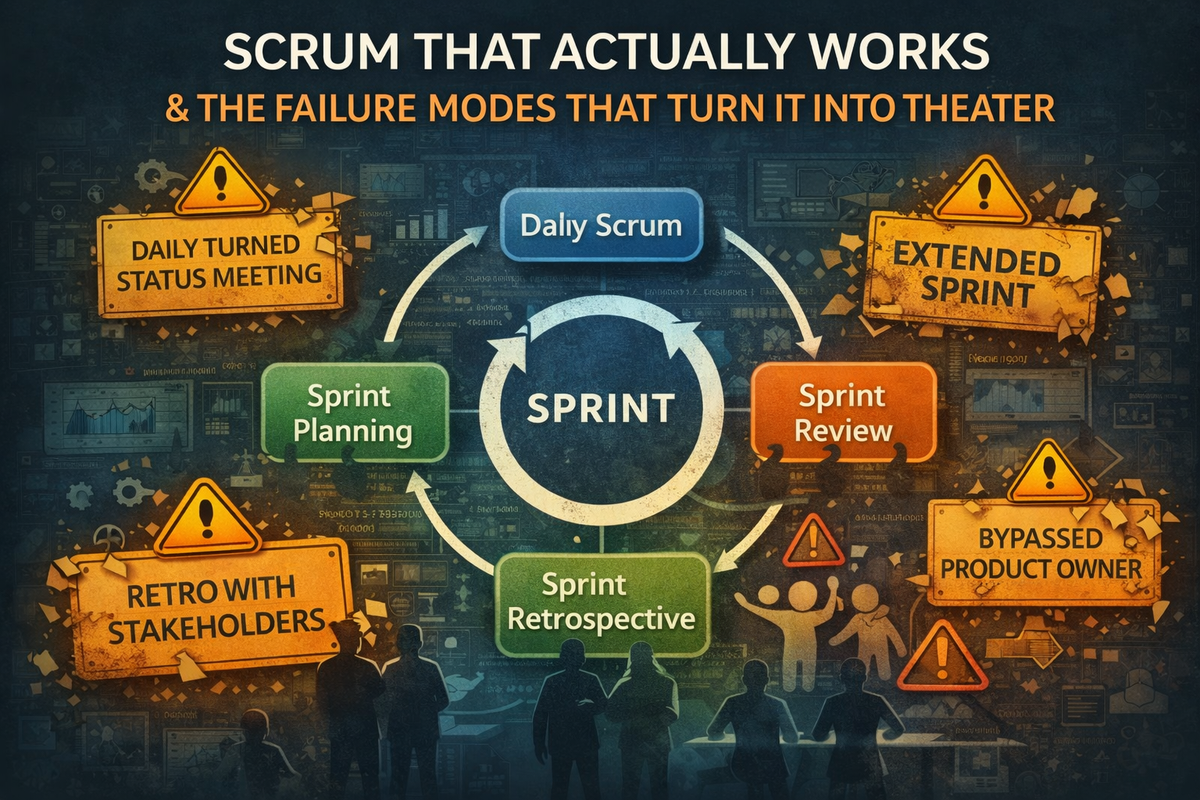
When those two things break, Scrum turns into theater:
- the Daily becomes a status meeting,
- the Sprint "commitment" becomes fiction,
- the backlog stops reflecting reality,
- and the team starts "finishing after the sprint" just to survive deadlines.
A 2024 case study in a public organization captures this perfectly. It shows Scrum working when the feedback loop is protected—and breaking the moment stakeholders and management pressures leak into the wrong places (Daily, Retro, and priority changes that bypass the Product Owner). I'm attaching the original paper in this post so you can read it end-to-end; what follows is the practical distillation: what to keep, what to stop, and the minimum rules that make Scrum actually deliver.
TL;DR
- Scrum works when Transparency → Inspection → Adaptation stays real, not performative.
- Daily Scrum is for developers; stakeholder participation turns it into status reporting.
- Priority changes that bypass the Product Owner destroy planning integrity and create reactive delivery.
- Retrospectives shouldn't include stakeholders—it reduces psychological safety and kills honesty.
- "Finishing after the sprint" and extending sprints is usually a slicing/refinement failure; incomplete work should return to the backlog.
- If developers are pulled mid-sprint for external requests, you need an explicit interrupt/on-call policy or Scrum becomes fiction.
- If your tool/backlog isn't updated, inspection is fake and Scrum collapses into storytelling.
What Scrum Is Actually Optimizing
Scrum is not "the sprint ritual set."
It's a constraint system for building software when scope is uncertain, requirements change, and delivery risk is constant. That's why the framework insists on formal events—Sprint Planning, Daily Scrum, Sprint Review, Sprint Retrospective—each timeboxed, each designed to enforce inspect/adapt behavior.
The Scrum Guide frames the whole thing around three pillars: Transparency, Inspection, and Adaptation. Everything else is a mechanism to keep those pillars alive under uncertainty.
If you remember only one thing: Scrum works when information stays fresh and decision rights stay clear. Scrum fails when either becomes blurry. This case study shows both.
What Worked (and Why)
Fixed cadence stabilizes everything
The team ran two-week sprints by agreement, which aligns with Scrum's "one month or less" constraint. The point isn't that two weeks is optimal—it's that fixed timeboxes force prioritization and surface reality faster than any planning document.
Sprint Review happened consistently
The Sprint Review was always held, and stakeholders consistently participated. That matters because Review is where results get inspected and adaptations are decided. When this event works, you get real feedback. When it's skipped or hollow, you're flying blind.
Retrospective happened consistently (necessary, but not sufficient)
The Retro was always held too. The event existing is necessary but not sufficient—how it's conducted is the difference between continuous improvement and team performance theater.
What Broke (The Failure Modes That Matter)
These are the patterns you should steal for your own "anti-pattern radar."
1. Stakeholders in the Daily Scrum turns it into status reporting
The paper's finding is blunt: the Daily Scrum is focused on developers; stakeholders joining only makes sense for specific clarification. Constant stakeholder participation turns the Daily into a meeting, breaking its purpose and timebox.
Translation: If your daily feels like "tell leadership what you did," you're not inspecting a sprint goal—you're generating optics.
Fix: Daily = developers + sprint goal + next 24 hours. Stakeholders can join the last 2 minutes for clarifying questions only, or attend a separate sync.
2. Priority changes bypassing the Product Owner break decision integrity
The study reports priority changes happening "directly" with managers or with the Scrum Master, while the Product Owner reported not being aware. The Scrum Guide is clear: changes should occur by convincing the PO, who is solely responsible for backlog priority.
This is a core failure mode: When decision rights are unclear, priorities mutate mid-sprint, and the team becomes reactive instead of focused.
Fix: Make it a rule: No priority changes without PO acknowledgment. If your org can't respect that, stop pretending you're running Scrum—run Kanban with explicit service classes and interrupt policies instead.
3. Stakeholders in Retros create silence and kill honesty
The paper calls out that stakeholders participating in retrospectives is not foreseen by the framework and can cause discomfort, limiting discussion due to fear of exposure and shifting the meeting's focus.
This is one of the most common "Scrum looks fine on paper" problems. The Retro exists for the team to surface what's actually broken. That requires psychological safety. Stakeholder presence—especially management—destroys it.
Fix: Retro is for the Scrum Team only. If leadership wants feedback, extract a sanitized "themes + actions" summary—no quotes, no naming, no blame.
4. "Extending" sprints and dragging work forward signals broken slicing
The study notes cases where agile practices were abandoned due to unenforceable deadlines, and teams kept working after the sprint to deliver incomplete items. The Scrum Guide's answer: unfinished PBIs return to the backlog and should be refined into smaller pieces.
Translation: When you extend sprints or "just finish it after," you stop getting feedback. Scrum becomes waterfall with weekly check-ins.
Fix: If work doesn't fit, split it until it does. "But it's one feature" isn't an argument—it's a signal your vertical slicing is broken.
5. Developers pulled mid-sprint for external requests destroys predictability
The study observed developers being pulled during sprints to support external demands, often requested by stakeholders, decreasing the team's ability to deliver value.
This is death by a thousand cuts. Every interruption fragments focus, extends cycle time, and makes sprint commitments meaningless.
Fix: You need an interrupt policy:
- Define a rotating "on-call" developer for unplanned support
- Cap interruptions per sprint (e.g., 10% of capacity)
- If you exceed the cap, reduce sprint scope explicitly
If you don't do this, sprint commitments are fiction.
6. User stories weren't understood—even by Scrum Masters
The paper notes Scrum Masters had difficulty understanding user stories, corroborated by stakeholders who defined the needs. This directly impacts Sprint Planning and estimation.
This isn't a "Scrum Master problem." It's a shared product discovery and refinement failure.
Fix: Make "Definition of Ready" real:
- Clear acceptance criteria
- Known constraints and dependencies
- Demo-able increment definition
- The whole team can explain what "done" looks like
7. The tool existed but wasn't updated—so inspection became fake
Despite having a tool with relevant project info, lack of frequent updating prevented reliable inspection and reporting. The paper explicitly ties this to transparency/inspection/adaptation breaking down.
Translation: If Jira isn't current, Scrum events become storytelling sessions.
Fix: If it's not updated daily, it isn't a system of record. Make updating part of "done."
The Two Things Scrum Is Fragile To
This case study screams two principles:
- Decision rights must be respected—especially PO authority on priority. When anyone can change priorities mid-sprint, planning becomes theater.
- Artifacts must reflect reality—tool and backlog freshness. When the board lies, inspection is impossible and adaptation is random.
When teams ignore the guide's constraints, Scrum becomes "frivolous" (the paper's word) and stops delivering value. Strong wording, but accurate.
A "Minimum Viable Scrum" Playbook
If you want Scrum without the ceremony inflation, here's what to keep and what policies to make explicit:
Keep these non-negotiable
- Sprint Goal (one sentence, shared understanding)
- Timeboxed Daily (developers only, goal-focused, 15 minutes max)
- Sprint Review (stakeholders welcome, inspect real working software)
- Sprint Retrospective (team only, produce 1–2 actionable changes)
Make these policies explicit
Most orgs refuse to be honest about these. Write them down anyway:
- Priority changes require PO acknowledgment—no exceptions
- No sprint extensions. Incomplete work returns to backlog and gets re-sliced.
- Interrupt policy: define on-call rotation + cap interruptions per sprint
- Tool hygiene: ticket states must reflect reality daily
Measure outcomes, not participation
Track these instead of "velocity":
- Lead time / cycle time (how long from idea to production)
- Escaped defects (quality feedback)
- Carryover rate (are you finishing what you start?)
- Unplanned work rate (how much chaos vs. planned delivery?)
- Retro action completion rate (are improvements actually happening?)
If these don't improve quarter over quarter, your Scrum is either being gamed or constrained by dependencies you haven't acknowledged.
Reference
I'm attaching the original paper in this post so you can read it end-to-end:
Pinto, J.S. & Leme, R.S. (2024), "Analysis of project management principles with the Scrum framework in systems development: a case study in a public organization", Brazilian Journal of Operations and Production Management, Vol. 21, No. 2, e20241878.
Closing
Scrum isn't magic. It's a set of constraints designed to force clarity—about what you're building, who decides what matters, and whether reality matches the plan.
The framework fails when organizations treat it as ritual rather than discipline. Daily standups without sprint goals are just meetings. Retrospectives with stakeholders present are just performance reviews. Backlogs that don't get updated are just wish lists.
But when you protect focus, respect the PO's authority over priority, and keep artifacts honest? Scrum does what it promises: short feedback loops, early course correction, and software that ships.
The choice isn't "do Scrum" or "don't do Scrum." It's: are you willing to enforce the constraints that make it work?